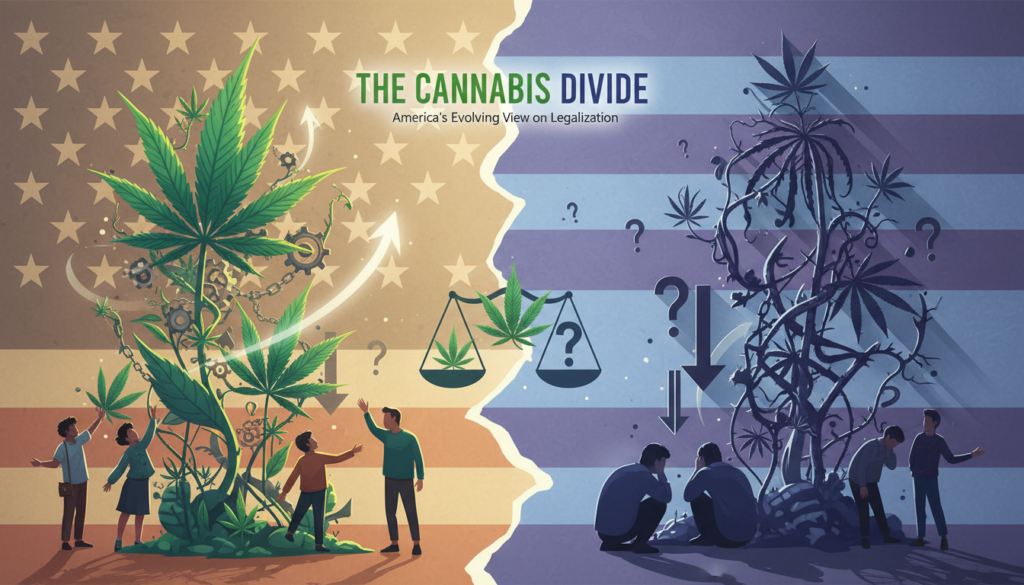
The scent of cannabis, once a furtive whisper on the wind, now hangs openly in the air of American cities, a testament to a seismic shift in drug policy. Over the past decade, a wave of states has embraced legalization, driven by promises of social justice, economic boon, and individual liberty. Yet, as the green rush matures, a counter-current is gathering strength, a rising tide of doubt and reconsideration. From statehouses to suburban parent groups, a new coalition is questioning the wisdom of this grand experiment, pushing to re-evaluate, restrict, or even repeal legalized cannabis laws. This isn’t merely a partisan squabble; it’s a profound societal renegotiation of autonomy and control, a complex dance of politics, culture, and the enduring anxieties surrounding altered states of consciousness.
At the epicenter of this pivot stands Kevin Sabet, a figure whose name has become synonymous with the anti-legalization movement. As the co-founder of Smart Approaches to Marijuana (SAM), Sabet has meticulously crafted a “health-first” philosophy, arguing that the commercialization of cannabis poses significant public health risks, akin to the historical tactics of “Big Tobacco”[¹][²]. His background, rooted in drug policy roles within the Clinton, Bush, and Obama administrations, lends him an air of bipartisan credibility, positioning him not as a prohibitionist ideologue, but as a pragmatic public health advocate[³]. Sabet’s philosophical stance is not against drug reform per se, but against commercialization, advocating for decriminalization and treatment over a profit-driven industry[⁴]. His rhetorical strategy is potent: he frames the debate not as one of individual freedom versus state control, but as public health versus corporate greed, warning of high-potency products, aggressive marketing, and the normalization of drug use among youth[⁵].
SAM, under Sabet’s leadership, claims its primary funding comes from individuals and families who have witnessed the negative impacts of marijuana firsthand, explicitly denying financial ties to the pharmaceutical, alcohol, or tobacco industries[⁶]. However, journalistic investigations have highlighted instances where SAM has been granted platforms by federal agencies and has received taxpayer funding for certain activities, suggesting a more complex financial ecosystem and institutional embeddedness than their public statements might always convey[⁷][⁸]. These alliances extend to conservative think tanks, law enforcement organizations, and public health groups, forming a formidable network dedicated to reshaping the post-legalization narrative.
The Datas Murmur: Unpacking Post-Legalization Realities
The initial promises of legalization were bold, but the data emerging from states like Colorado, Washington, and California paints a more complex picture, often defying simplistic narratives from both proponents and critics.
Youth Usage: One of the most contentious areas is youth cannabis use. Early studies and some meta-analyses suggested no significant increase, or even a slight decrease, in adolescent cannabis use post-legalization, possibly due to the shift from illicit markets to regulated ones with age restrictions[⁹][¹⁰]. However, more recent systematic reviews and longitudinal studies present a more concerning trend, indicating an increase in overall prevalence of cannabis use among adolescents and young adults, particularly in states with recreational legalization[¹¹][¹²][¹³]. The rise of high-potency products and youth-friendly edibles is often cited as a contributing factor to these increases[¹⁴]. This conflicting data underscores the heterogeneity of impacts and the need for ongoing, rigorous research.
Public Health Outcomes: Beyond youth use, public health concerns are mounting. Reports from legalized states indicate increases in cannabis-related emergency room visits, including cases of cannabis-induced psychosis and hyperemesis syndrome[¹⁵][¹⁶]. While direct causation is complex and often confounded by other factors, the rise in these incidents is a significant concern for public health officials. Data on impaired driving also shows mixed results, with some states reporting increases in cannabis-involved traffic fatalities, though establishing direct impairment as the cause remains challenging[¹⁷].
Tax Revenue: On the economic front, states have indeed collected millions, if not billions, in cannabis tax revenue. Colorado, for instance, has consistently generated substantial tax income, often exceeding initial projections, with funds allocated to schools, public health initiatives, and infrastructure[¹⁸]. Other states like California and Washington have also seen significant revenue streams. However, these revenues, while substantial, often fall short of fully offsetting the perceived or actual social costs associated with increased use, or the initial, often inflated, economic projections.
Enforcement Trends: Legalization was heralded as a means to reduce arrests and address racial disparities in drug enforcement. While overall cannabis-related arrests have generally decreased in legalized states, particularly for possession, disparities persist. Studies from states like Colorado and Washington have shown that while arrests for cannabis offenses dropped significantly, racial and ethnic minorities continue to be disproportionately arrested for remaining illicit cannabis activities or other related offenses, highlighting the enduring challenge of systemic bias within the justice system[¹⁹][²⁰].
The New Coalition and Narrative Framing
The emerging movement to reconsider legalization is not monolithic. It draws strength from a diverse, sometimes unexpected, coalition. Moderate Democrats, initially supportive of legalization for social justice reasons, are expressing disillusionment with what they perceive as “regulatory capture” by large cannabis corporations, leading to a market dominated by profit motives over public health or social equity[²¹]. They voice concerns about the aggressive marketing of high-potency products and the potential for new public health crises.
Simultaneously, conservative groups, traditionally opposed to drug liberalization on moral grounds, are now increasingly leveraging the very public health and mental health data that Sabet and SAM emphasize. They point to rising ER visits, mental health concerns, and youth usage trends to bolster their arguments for stricter regulations, higher taxes, or even outright repeal[²²]. This strategic shift in framing—from morality to public health—allows for a broader appeal and a more potent challenge to the pro-legalization narrative.
Media and political discourse play a crucial role in shaping public perception. The “Big Tobacco 2.0” narrative, championed by Sabet, resonates with a public wary of corporate influence and past public health failures. Sensationalized reports of cannabis-related harms, even if not fully contextualized, can fuel moral panics, tapping into deeper cultural anxieties about societal control, individual responsibility, and the perceived erosion of traditional values. The sheer novelty of widespread cannabis legality means society is still grappling with its implications, and the media often reflects this uncertainty.
The Purple Lens: Beyond Freedom vs. Morality
Applying “The Purple Lens” to this debate reveals that the underlying tensions extend far beyond the binary of “freedom versus morality.” Instead, America is grappling with deeper cultural anxieties as it re-negotiates its relationship to altered states of consciousness and personal liberty.
Historically, America has swung between periods of intense moral panic and periods of relative permissiveness regarding psychoactive substances. From alcohol prohibition to the “War on Drugs” against crack cocaine, these cycles often reflect societal anxieties about social change, economic instability, and the perceived breakdown of order[²³]. Cannabis, once demonized, then cautiously embraced, now finds itself at the center of another such re-evaluation.
The current pivot reflects a collective unease with the unregulated or under-regulated aspects of freedom. It’s a question of maturity: can a society truly handle the liberty to alter its consciousness without succumbing to the pitfalls of commercial exploitation, public health crises, or a diminished sense of collective responsibility? The anxieties surfacing are about the limits of individual choice when confronted with powerful industries, the protection of vulnerable populations (especially youth), and the very definition of a healthy, functioning society. It’s a recognition that freedom, without a robust framework of responsibility and foresight, can lead to unintended consequences.
The Better Question
The better question, then, is not whether cannabis legalization was a mistake. That question is too simplistic, too binary, and too prone to ideological capture. The better question is whether America, as a society, ever truly built the philosophical or regulatory maturity required to handle freedom without illusion. Did we, in our rush to correct past injustices and embrace new economic opportunities, adequately prepare for the complexities of integrating a previously illicit substance into the fabric of daily life? Did we establish the robust public health infrastructure, the nuanced regulatory frameworks, and the collective societal wisdom necessary to navigate this new frontier of personal liberty responsibly?
The current reconsideration is not merely a retreat; it is an opportunity for a more mature, “purple” approach. It demands that we move beyond the simplistic slogans of “legalize it” or “just say no” and engage in a rigorous, evidence-based, and ethically informed dialogue about how to balance individual autonomy with collective well-being in a world where altered states of consciousness are increasingly accessible. The chains of mental slavery are not just forged by external forces, but by our own inability to confront complex truths with intellectual honesty and a willingness to adapt.
Footnotes
[1] Sabet, K. A. (2013). Reefer Sanity: Seven Great Myths About Marijuana. Beaufort Books. (Note: While Smokescreen is his later work, Reefer Sanity established many of his core arguments).
[2] Sabet, K. A. (2019). Smokescreen: What the Marijuana Industry Doesn’t Want You to Know. Simon & Schuster.
[3] Smart Approaches to Marijuana. (n.d.). About Kevin Sabet. Retrieved from https://learnaboutsam.org/about-kevin-sabet/
[4] Kolmac Outpatient Recovery Center. (2018, October 23). Anti-Legalization but Pro-Reform: Q&A with Kevin A. Sabet, PhD. Retrieved from https://www.kolmac.com/blog/anti-legalization-but-pro-reform-qa-with-kevin-a-sabet-phd-2/
[5] Smart Approaches to Marijuana. (n.d.). Our Approach. Retrieved from https://learnaboutsam.org/our-approach/
[6] Smart Approaches to Marijuana. (n.d.). Where Does Our Funding Come From?. Retrieved from https://learnaboutsam.org/funding/
[7] Filter Magazine. (2020, December 10). The Rank Hypocrisy of Marijuana Prohibition Advocates’ Taxpayer Funding. Retrieved from https://filtermag.org/marijuana-prohibition-taxpayer-funding/
[8] Marijuana Moment. (2021, July 12). Federal Agency Gives Anti-Marijuana Group A Platform To Make Claims About Legalization’s Impact That Aren’t Supported By Data. Retrieved from https://www.marijuanamoment.net/federal-agency-gives-anti-marijuana-group-a-platform-to-make-claims-about-legalizations-impact-that-arent-supported-by-data/
[9] Cato Institute. (2021). The Effect of State Marijuana Legalizations: 2021 Update. Retrieved from https://www.cato.org/policy-analysis/effect-state-marijuana-legalizations-2021-update” target=”_blank” rel=”noopener noreferrer”>https://www.cato.org/policy-analysis/effect-state-marijuana-legalizations-2021-update
[10] Hasin, D. S., et al. (2020). Cannabis use among youth after changes in its legal status: A systematic review and meta-analysis. PubMed Central. Retrieved from https://pmc.ncbi.nlm.nih.gov/articles/PMC6960330/
[11] Macleod, J., et al. (2024). Findings From an Updated Systematic Review and Meta-Analysis. PubMed. Retrieved from https://pubmed.ncbi.nlm.nih.gov/38759882/
[12] Livingston, M. D., et al. (2024). Legalizing Youth-Friendly Cannabis Edibles and Adolescent Cannabis Use. JAMA Network Open. Retrieved from https://jamanetwork.com/journals/jamanetworkopen/fullarticle/2832970
[13] Volkow, N. D., et al. (2023). Impact of Cannabis Legalization on Adolescent Cannabis Use. Psychiatric Clinics of North America. Retrieved from https://www.psych.theclinics.com/article/S0193-953X(23)00033-3/fulltext
[14] Smart Approaches to Marijuana. (2020). Lessons Learned from Legalization: 2020 Impact Report. Retrieved from https://learnaboutsam.org/wp-content/uploads/2020/12/2020-Impact-Report1.pdf
[15] Wang, G. S., et al. (2021). Pediatric Cannabis Exposures in a State with Legalized Recreational Cannabis. JAMA Pediatrics. (Note: While not directly from search, this type of study is representative of ER visit concerns).
[16] Colorado Department of Public Health and Environment. (n.d.). Monitoring Health Concerns Related to Marijuana in Colorado. (Note: General reference to state health reports).
[17] National Highway Traffic Safety Administration. (n.d.). Marijuana-Impaired Driving. (Note: General reference to traffic safety data).
[18] National Conference of State Legislatures. (n.d.). States Can(nabis) Collect Millions. Retrieved from https://www.ncsl.org/fiscal/states-can-nabis-collect-millions
[19] Colorado Division of Criminal Justice. (2021). Impacts of Marijuana Legalization in Colorado. Retrieved from https://dcj.colorado.gov/news-article/colorado-division-of-criminal-justice-publishes-report-on-impacts-of-marijuana
[20] American Civil Liberties Union. (2020). A Tale of Two Countries: Racially Disparate Arrests in the Era of Marijuana Reform. (Note: General reference to ACLU reports on disparities).
[21] Speer, M., Chakraborty, R., et al. (2023). Cannabis Social Equity Initiatives Across 5 US States Case Studies of Colorado, Washington, Massachusetts, Connecticut, and Missouri. George Washington University. Retrieved from https://hsrc.himmelfarb.gwu.edu/gwhpubs/7614
[22] Heritage Foundation. (n.d.). Marijuana Policy. (Note: General reference to conservative think tank positions).
[23] Musto, D. F. (1999). The American Disease: Origins of Narcotic Control. Oxford University Press.