
Present complex truths accessibly; condescension erodes trust.
Interpretation of the Law
Lasting influence begins with a single discipline: making the complex feel earned rather than imposed. The ethical influencer doesn’t simplify by stripping away truth. They simplify by meeting the audience at the level of their existing knowledge and walking forward from there, trusting that people who feel respected will follow further than people who feel lectured at ever will.
Cicero, the Roman orator who shaped the rhetorical tradition of the Western world. He didn’t build his authority on the display of philosophical learning, he built it on the art of making abstract stakes feel immediate and personal. He addressed senators and street vendors in the same breath, using the rhythms of everyday Roman life to make treason, justice, and civic obligation feel like matters the audience already understood and cared about.
P.T. Barnum built the 19th century’s most successful entertainment empire on a related principle: that crowds do not want to be told what to marvel at. They want to discover it themselves. His promotions were engineered to make ordinary people feel like insiders to extraordinary things, and the loyalty that produced was the kind that filled tents year after year rather than once.
Bellingcat publishes satellite geolocation tutorials and OSINT methodology guides written as though explaining the work to a curious, intelligent teenager encountering it for the first time. The result is an investigative community of millions who trust the process not despite its accessibility but because of it, because being taught rather than dazzled is a form of respect that compounds over time.
The law demands restraint: withhold jargon, unpack abstractions, and frame insights as collaborative discoveries. Audiences reward those who elevate without condescension with a loyalty that withstands scrutiny precisely because it was built on understanding rather than deference.
Insight: “The first duty of the orator is to speak in a manner suited to persuade; the second is to speak in a manner suited to the dignity of the subject; the third is to speak in a manner suited to the audience.” (Cicero, 106–43 BC)
Observance of the Law
Rome, 63 BCE. Cicero rises before the Senate crooning carols of Catilinarian conspiracy, a plot to overthrow the Republic by a disaffected aristocrat whose allies sat in the room while he speaks. The stakes were abstract to most Romans: constitutional procedure, senatorial authority, the mechanics of political treason. Cicero made none of it abstract. He opened with a direct address that turns Catiline’s presence in the Senate chamber into a visceral insult everyone present felt: “How long, O Catiline, will you abuse our patience?” He drew his evidence from the textures of Roman daily life, the streets his audience walked, the markets they traded in, the civic loyalties they already held. He didn’t lecture on political philosophy. He assumed his audience is capable of grasping the full weight of what is happening if it’s simply placed before them clearly. The Senate acted. Catiline fled. The conspiracy collapsed. Cicero’s authority in that moment didn’t come from displaying superior knowledge; it came from trusting his audience with the truth at the same level they could receive it.
New York, 1842. P.T. Barnum introduces Charles Stratton, a five-year-old boy standing twenty-five inches tall, to the American press not as a medical curiosity to be examined but as General Tom Thumb, a character Barnum had trained Stratton to inhabit with full theatrical commitment: Napoleon impressions, military costumes, scripted wit delivered with the confidence of a performer twice his age. Rather than position the audience as observers of a phenomenon they’re being asked to evaluate, Barnum positioned them as discoverers of a marvel they’ve been invited to share. Reporters who visited Barnum’s American Museum didn’t feel instructed. They felt delighted. The distinction mattered: delight is something you return to, instruction is something you endure. Barnum’s tours sold out across the United States and Europe because he understood that accessibility isn’t condescension toward the audience. it’s confidence in them.
The contrast arrives in 2018 at the White House briefing room, where CNN’s Jim Acosta adopts a prosecutorial demeanor towards Donald Trump, the President. The questions were often legitimate but the tone wasn’t accessible. It was adversarial in a way that didn’t signal, to a significant portion of the audience, that they were being informed. Instead, he seemed to be correcting them. Gallup polling across 2017-2019 showed media trust among conservative audiences declined by roughly 56% as the perception of elite condescension hardened. Meanwhile, Bellingcat published its MH17 geolocation methodology with step-by-step annotations: zoom to this coordinate, match this shadow angle, compare this vehicle marking against this registry entry. The reader wasn’t being shown what to conclude; they were being shown how to arrive there themselves. The reason almost ten million people engage with Bellingcat isn’t because they’re authoritative in tone but because they’re generous in method, and generosity of method is the deepest form of respect an investigator can show an audience.
Cognitive load theory explains the mechanism: when complex information is presented accessibly, processing resistance drops and retention rises, not because the audience has been simplified down to but because the pathway’s been cleared for them to think clearly. John Sweller’s foundational research established that working memory is finite, and that any communicator who forces an audience to decode presentation style simultaneously with content has already lost half the minds that they’re trying to reach. Cicero stripped constitutional complexity down to the textures of Roman daily life so that senators and street vendors could process the full weight of treason without the friction of unfamiliar abstraction. Barnum designed discovery rather than instruction so that the audience’s working memory spent itself on wonder rather than on translating his meanings. Bellingcat built it into institutional practice, publishing methodology guides that assume intelligence and withhold nothing, clearing the path so the reader arrives at the conclusion by their own verified route. The law’s shadow side is equally mechanical: Hillary Clinton’s “basket of deplorables” told swing-state voters what they were before asking what they thought; Sam Bankman-Fried deployed effective altruism vocabulary as a substitute for the transparency he was actively withholding; the Grievance Studies academics whose peer review arrogance had made their own field incapable of catching the hoax their condescension had invited. The audience that has been told it can’t understand will eventually demonstrate that it understands perfectly, including the contempt in which it’s been held, and it doesn’t forgive that.
Keys to Influence
Analogize Relentlessly: Frame technical concepts through metaphors the audience already owns, Bellingcat’s “satellite shadows work like sundials” does more work than three paragraphs of geolocation theory.
Ask Collaborative Questions: “Notice how this timestamp doesn’t match the shadow angle? What does that suggest?” makes the audience a co-investigator rather than a passive recipient of conclusions.
Layer Complexity: Begin at the level of shared knowledge and add depth as the audience earns it, Murrow’s radio broadcasts moved from observable fact to implication to judgment in that sequence, never reversing it.
Test Accessibility: If the person you respect most who knows nothing about this topic cannot follow it, it’s not ready.
Celebrate Audience Insight: “Readers identified this discrepancy before we did, here is the verification” isn’t false modesty. it’s the most powerful trust signal available.
Eliminate Jargon on First Contact: Every acronym explained at first use, every technical term given a plain-English equivalent the first time it appears, no exceptions.
Transgression of the Law
The transgressor of Law 1 doesn’t usually set out to condescend. They set out to demonstrate competence, to establish authority, to signal that they belong among the serious. What they produce instead is the precise condition that closes minds: the audience’s recognition that they’re being talked down to, which activates defensiveness, not curiosity, and certainly not persuasion over resistance.
Rome, 53 BCE. Crassus, the wealthiest general in the Republic, marches seven legions into Parthia on the strength of reputation rather than reconnaissance, lecturing his officers on military strategy while dismissing the intelligence his scouts have returned about Parthian cavalry formations. The expertise he performed in those councils of war wasn’t matched by the verified knowledge he refused to acquire. At Carrhae, the Parthians demonstrated what the scouts already knew: that Crassus’ arrogant assumptions were catastrophically incorrect. Seven legions were destroyed. His severed head was delivered to the Parthian king as a prop in a theatrical performance, the final deed of a campaign that began with a general too confident in his own superior knowledge to learn from people positioned to know better.
New York, September 9, 2016. Hillary Clinton stands before a fundraising crowd and characterizes half of Donald Trump’s supporters as belonging in “a basket of deplorables.” The framing wasn’t a gaffe of tone. It was a structural error: the assumption that the audience’s position had already been diagnosed and required no further investigation. Swing-state voters who felt lectured at rather than addressed didn’t patently announce their objection; but certainly registered it in November.
Sam Bankman-Fried lectures retail investors on effective altruism and the moral calculus of wealth redistribution while, inside FTX, customer funds are being systematically misappropriated through Alameda Research. The vocabulary of moral and financial sophistication wasn’t incidental to the fraud; it was its primary instrument, deployed to position him as the adult in the room whose judgment didn’t require scrutiny. The Grievance Studies academics whose fabricated papers sailed through peer review in 2017 and 2018 discovered the same dynamic from the inside: institutional condescension had made their field’s review processes incapable of catching the hoax their own arrogance had invited. In both cases the performance of superior knowledge had severed the feedback loop that would have caught the failure before it became public.
The mechanism running beneath all four isn’t arrogance in the ordinary sense. It’s a specific cognitive error: the assumption that performing superior knowledge is the same as possessing it, and that an audience which doesn’t visibly object has accepted the hierarchy being imposed on it. The performance becomes a blindfold. The communicator stops receiving information from the audience because they’ve already decided the audience has nothing useful to offer, and in that closed loop they lose access to exactly the corrective signal that would have saved them. The crowd doesn’t announce the moment it stops following. It simply stops, and by the time the absence is measurable, the authority that depended on their deference has already dissolved.
Interlude
The Parable of the Sower (Matthew 13:3-8):
“A farmer went out to sow his seed. As he was scattering the seed, some fell along the path, and the birds came and ate it up. Some fell on rocky places, where it did not have much soil. It sprang up quickly, because the soil was shallow. But when the sun came up, the plants were scorched, and they withered because they had no root. Other seed fell among thorns, which grew up and choked the plants. Still other seed fell on good soil, where it produced a crop – a hundred, sixty or thirty times what was sown.”
PURPLE SHADOW: Condescension & “JAQing off” (Just Asking Questions)
The Deception
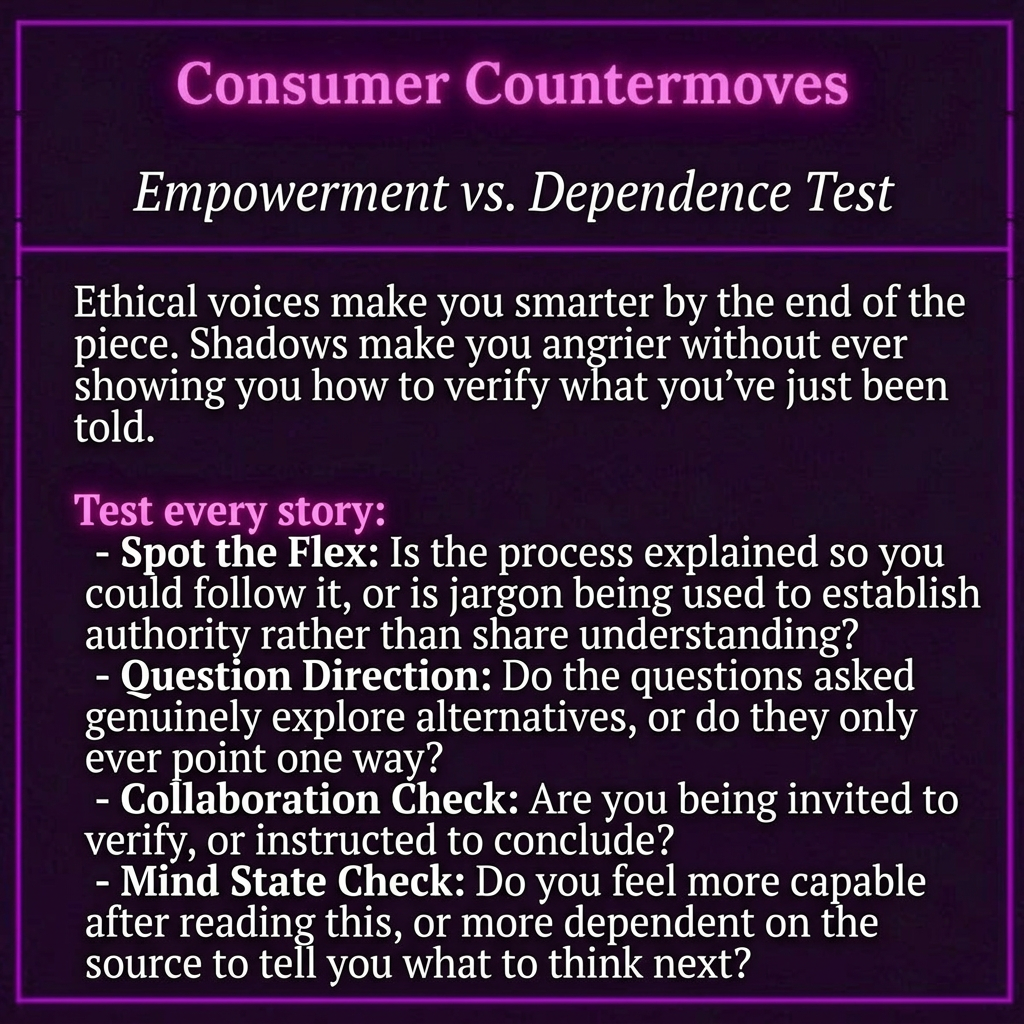
The shadow practitioner performs humility while engineering conclusions. “I’m just asking questions” presents itself as open inquiry while functioning as predetermined verdict delivered through plausible deniability. The audience is treated as incapable of handling direct claims, so claims are smuggled in as questions that always point in one direction, never exploring alternatives, never following the inquiry where evidence leads rather than where the narrative requires. The condescension is buried in the format: the practitioner who “just asks questions” has already decided the answer and assumed the audience can’t detect the manipulation.
Caveat: A note on the distinction the book requires here: Law 18 argues that feigning simplicity through naive questioning is one of the most powerful investigative methods available. Readers will recognize the apparent contradiction. It is not one. The shadow this section names deploys the question as a destination, not a method. The genuine naive question of Law 18 is willing to arrive anywhere the evidence leads, including at the questioner’s own error. The shadow question here arrives only where it was always going, and the performance of curiosity is the mechanism that conceals the predetermined route. Socrates asked Laches to define courage and accepted that neither of them could do it. The JAQing practitioner asks whether the election was stolen and accepts only one answer. The form is the same. The willingness to be wrong is the difference between them.
The Self-Destruction
Discerning audiences recognize the pattern before they can name it. Questions that never produce exculpatory results, inquiries that never genuinely consider alternative explanations, “investigations” that arrive at predetermined conclusions regardless of what the evidence shows: these aren’t subtle. When real investigators document the selective framing, the credibility damage is compounded by the original condescension. The audience doesn’t merely lose trust in the specific claim. They feel retrospectively mocked for having trusted the format at all. Legal liability accelerates the collapse: courts have become increasingly hostile to “just asking” as a shield against defamation, recognizing that implied assertions carry the same legal weight as direct ones.
Real-World Examples
Alex Jones, InfoWars: “I’m just asking whether Sandy Hook was staged” generated years of audience harassment against the families of murdered children and culminated in a $1.44 billion defamation verdict, the largest in American media history, after courts rejected the “just asking” defense as a fig leaf for direct false assertion.
CNN’s Jim Acosta (2017-2019): Sustained “what did he know and when did he know it” framing on Russia without proportionate evidentiary documentation produced the “fake news” counter-narrative it was ostensibly exposing, as audiences on both sides recognized the prosecutorial posture masquerading as inquiry.
Breitbart “Questions Remain” Coverage: A sustained editorial pattern of implying guilt through unanswered questions, several of which required retraction under legal pressure, eroded the outlet’s credibility among readers who had initially trusted its rigor precisely because the pattern became recognizable as a format rather than a genuine investigative posture.
The purple path trusts the audience with the full weight of the truth and earns a loyalty that compounds. The shadow assumes the audience cannot detect the manipulation and discovers, always too late, that they detected it from the first question that never led anywhere.
Footnotes
[1] inline
[2] merged
[3] external