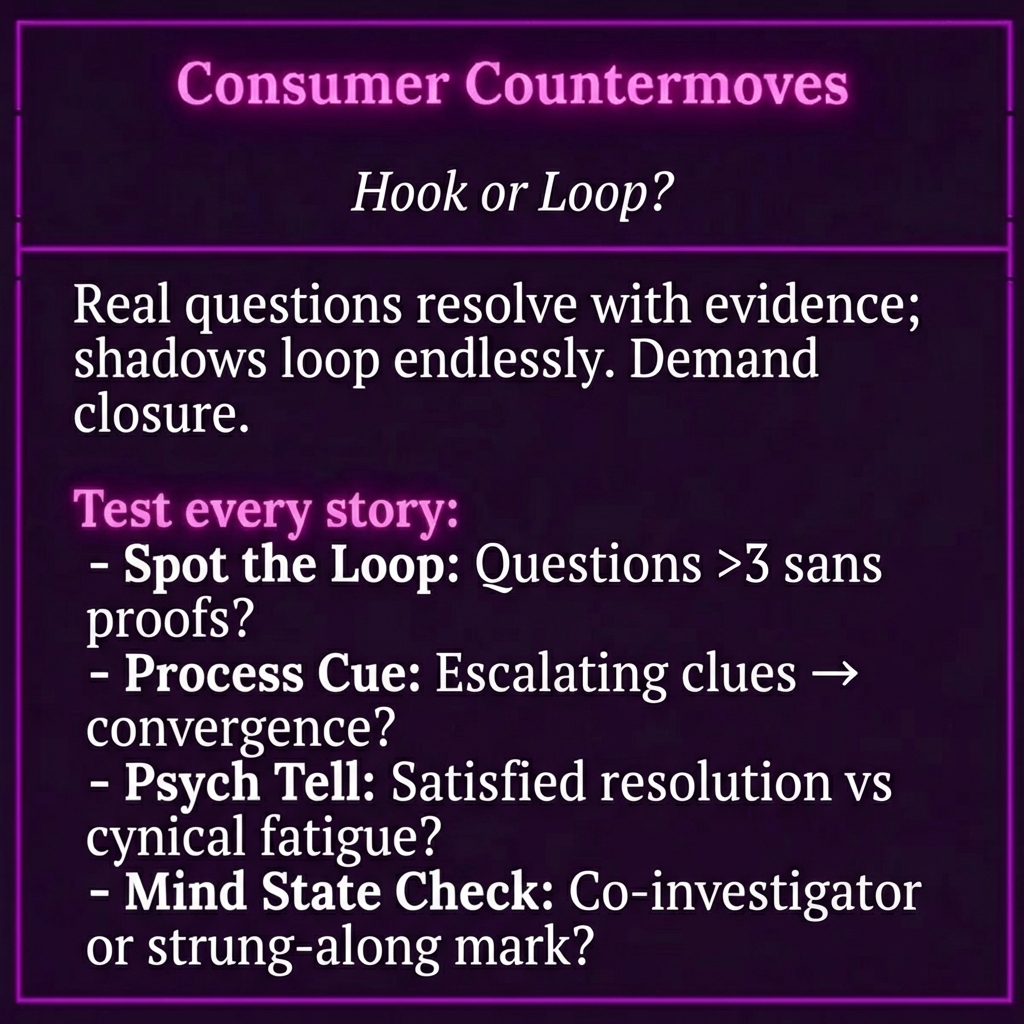
Provoke curiosity with open questions, deliver certainty with ironclad facts.
Interpretation of the Law
Ethical influencers wield the one-two punch of human psychology: unanswered questions spark insatiable curiosity while unassailable evidence delivers satisfying resolutions. Socrates baited Athenian youths asking “What is justice?” then dismantled any weak definitions with lively dialogue. Using thought provoking examples like repayment of weapons to a madman and asking what good is there in a cobbler doing a carpenters work he exposed contradictions without the need for formal records.
Frederick Douglass challenged slaveholders with “Must I argue that a system marked with blood is wrong?” and then set the hook with testimony of Aunt Hester’s whipping, his mother’s 12-mile nightly walks, and self-taught literacy through daily newspapers that demonstrated, despite the prevailing belief of the day, the humanity of the enslaved.
Bellingcats headlines hinting at ‘hidden knowledge’ provoked an almost irresistible curiosity with “Which convoy launched the MH17 missile?” which then converges satellite timestamps, separatist selfies, and sanctions lists on Russia’s 53rd Brigade.
ProPublica asks “Who owns your hospital’s debt?” then uses FOIA tables to exposes private equity takeovers profiting from patient suffering and, too often, death.. Mother Theresa style.
Curiosity opens the door; evidence escorts its entrance through it.
Observance of the Law
Athens, 399 BCE. Socrates confronts Meletus in the Agora: “Do you accuse me of corrupting youth, or merely failing to teach virtue?” as the crowd gathered. He then dismantles the charge through dialectic: “If I corrupt them, why don’t their families prosecute me?” and “Either the laws are corrupt, or I misunderstand them; which?” No execution-by-hemlock records, slave contracts, or Boule minutes; just relentless questioning exposing contradictions in Meletus’ logic; His dialectic didn’t save his life, but it moved a lot of hostiles
1845 Baltimore. Douglass escapes slavery, pens his Narrative. Rather than rage against masters, he poses: “By what right does Captain Auld claim my labor?” Exhibit A: Auld’s 1840 ledger showing Douglass valued at $300 beside horses at $150. Exhibit B: Maryland Circuit Court manumission records proving freedom petitions denied on technicalities. Exhibit C: U.S. Census slave schedules enumerating 2,873,648 souls as property. Northern readers who entered as curious observers exit as accomplices in abolition.
More than a century later in 1974 Washington, DC. Woodward and Bernstein don’t proclaim “Nixon covers up Watergate.” They ask: “Why did the Watergate plumbers carry $100 CIA-grade bugging gear?” Answer: CREEP finance records showing $25,000 hush money check to E. Howard Hunt, grand jury testimony linking John Mitchell’s safe, White House logs placing Nixon in meetings with laundered funds. Questions made readers detectives; evidence made them jurors.
Psychology explains the alchemy: The Zeigarnik effect holds unfinished mental tasks in memory (the rhetoric or dialect) – the mind craves closure and evidence completes the gestalt, forging a neural-type loyalty. Shadows of JAQ fail by looping questions endlessly while Purple mastery hooks then lands.. hard.
When CNN screamed, “What did Biden know about Hunter?” sans substance public trust eroded. Fox’s “Was 2020 stolen?” baited without ballot and got hit with a $787M verdict. Questions demand evidence and evidence demands fealty.
Keys to Influence
Zeigarnik Headlines: “Did this ledger prove slavery’s math?” prompts the audience to think about a complex issue and potentially leads them to further investigate auction tables, raising questions about the economic implications of slavery and making them eager to learn more.
Three-Question Ladder: scaffold questions to progressively deepen understanding and engagement. Easy -> Complex -> Open-ended; What is the primary function of a ledger? -> How could these ledgers affect perceptions of morality in trade? -> What systematic changes emerge from this data?
Dopamine Dosing: Pause after Clue #2: “Verify this yourself before proceeding.”
Convergence Convenience: “If three trails meet here what’s the probability of coincidence?”
Socratic Reasoning: “If X happened at timestamp Y, where must Z be?”
Ethical Escalation: Questions remain open even when evidence favors opponents.
Transgression of the Law
Asking loaded questions that smuggle false premises across critical borders poisons discourse, turning genuine curiosity into confirmation bias traps while evading accountability. Transgressors pose “innocent” queries, “How many crisis actors were at Sandy Hook?” or “When did they know about collusion?”, that presuppose unproven claims, harvesting outrage without risking direct falsehoods. The tactic thrives in the short-term. While audiences fill gaps with their own anger the ‘shares’ and ‘likes’ multiply as the malevolent questioner claims “just asking.”
Alex Jones mastered this in 2012 Sandy Hook coverage. “Why did the parents show up on camera smiling and laughing before they cried?”, “Why are there no bodies shown being carried out? Why did they leave the school unlocked? I’m just asking legitimate questions about what really happened.” loaded the hoax premise as his viewership spiked; Jones built a media empire, but when parents sued for defamation, Jones couldn’t “just ask” his way out. Courts demanded evidence of the hoax but, to many’s, especially Jones’, chagrin, none existed. The $1.5B verdict followed as parents proved real deaths through death certificates, photos and autopsies. Psychologically, loaded questions exploit a presupposition accommodation where the brain accepts embedded claims as true in order to process the question. From here repetition cascades into belief via the availability heuristic. But discerning audiences will eventually spot uni-directional questioning that never explores alternatives. Fact-checkers dismantle false premises. Courts reject “just asking” as a shield of malice when harm is proven. CNN’s Jim Acosta hammered “When did you know about Russian collusion?” during the 2018 briefings, presupposing the Mueller-proven conspiracy; but Mueller found no collusion, only obstruction. Acosta’s credibility eroded as the public saw selective outrage instead of journalism. Gallup reported that trust in CNN among independents dropped 12 points post-report. Breitbart’s “Questions Remain” series on 2021 Hunter laptop implied “Why no charges?” despite NY Post verification. When evidence solidified, “questions” became willful ignorance. Retractions followed amid plagiarism claims; being branded a “rigorous skeptic” became damaging as readers migrated to outlets publishing full evidence chains. The fallout compounds: sources withhold information from manipulative questioners; partners distance themselves; Legal discovery begins exposing patterns of bad-faith inquiry and networks fracture as theft of intellectual labor becomes visible. Loaded questions promise easy wins but deliver swift obsolescence when evidence demands answers they can’t supply.
PURPLE SHADOW: Fake Humility The Deception
“Just asking questions” plants predetermined conclusions while dodging evidence accountability. Endless “What did they know and when?” loops imply guilt without documentation and weaponizes curiosity against scrutiny.
The Self-Destruction One-way questioning patterns expose bad faith; courts pierce “just asking” defamation shields. Sources eventually ghost manipulators and loyalty never forms.
Real-World Examples
– CNN Russia Collusion (2017-19): “What ties did Trump have?” with no Mueller docs and then Mueller testified there was “no collusion.” – Fox Election Night (2020): “Irregularities everywhere?” ignored chain-of-custody and earned Dominion a $787M judgement. – MSNBC Kavanaugh (2018): They asked “What did he hide?” before looking at the yearbook and the FBI found no corroboration.