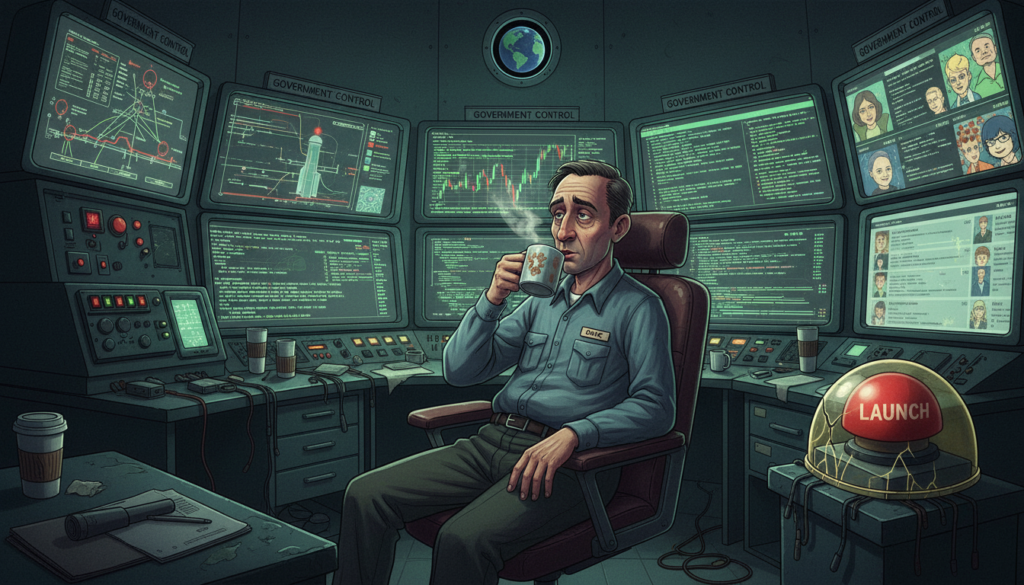
There exists, somewhere in the vast bureaucratic machinery of human civilization, a person whose job it is to ensure that nuclear weapons don’t accidentally get launched. This person, let’s call him Dave, probably has a mortgage; enjoys mediocre coffee; and occasionally forgets where they parked their car. Dave is, in other words, exactly as competent as the rest of us, which is to say: just barely enough to muddle through most days without setting anything important on fire.
This should terrify us..
And what should terrify us even more? Dave isn’t the exception; Dave is the rule. And once we understand this, once we truly internalize that we are a species of highly sophisticated apes who have somehow stumbled into operating fusion reactors, global financial systems, and TikTok algorithms – the entire chaotic mess of human history suddenly snaps into focus with the clarity of a perfectly focused natural disaster.
Welcome to Hanlon’s Razor: Never attribute to malice that which is adequately explained by stupidity.
Or, maybe better put: Never assume conspiracy when mass incompetence may help you sleep better.
I. The Firmware Problem
Let me be clear about what I mean by “stupidity.” I’m not talking about a lack of intelligence. Humans are, for the most part, quite clever. We’ve split the atom, mapped the genome, constructed vast global markets and invented both rolls of toilet paper and sliced bread. We’re brilliant!
We’re also running Stone Aged brains in Space Aged world, and the system needed an upgrade about 10,000 years ago.
We’re working with brains that evolved inside tribal-like social networks of about 150 people. The biggest dangers were four-legged predators and/or starvation and the critical daily decisions were which mushroom would kill you, which would sustain you and which made you fly. Now, that same brain, is expected to:
Negotiate a slew of complicated geopolitical issues involving unbalanced, nuclear powered egos
Understand the difference between exponential and incremental regarding growth curves during.. pandemics, for example
Make wise choices about cryptocurrency markets
Make equally wise choices about fiat currency markets
Navigate social media platforms designed by Stanford PhDs specifically to exploit our dopamine receptors
Comprehend that the thing in our pockets is more powerful than the computers that sent humans to the moon, and yet we primarily use it to look at pictures of dogs and couple comedy skits and porn.
Is it any wonder we’re struggling?
II. The Modern Condition: A Study in Systematic Stupidity
Let’s examine some recent examples of how our ancient brains are failing to keep up with our modern world.
Exhibit A: The 2024 CrowdStrike Incident
On July 19, 2024, a routine software update from cybersecurity firm CrowdStrike crashed 8.5 million Windows computers worldwide. Airlines grounded flights. Hospitals canceled surgeries. Banks couldn’t process transactions. The global economy coughed, gagged, hiccupped and started to choke.
The cause? A single faulty update file. Not a cyberattack. Not a coordinated assault on Western infrastructure. Just a bug that slipped through testing protocols.
The perfect irony – CrowdStrike is a cybersecurity company. Their entire business model is preventing exactly this kind of catastrophic failure. And yet, in trying to protect systems, they accidentally became the threat.
But it wasn’t malice. It wasn’t sabotage. It was a company of smart, hard working people following their processes and still managing to accidentally break a significant chunk of global infrastructure. Because that’s what happens when systems become too complex for any individual – or even any team – to grok or genuinely fathom.
Exhibit B: The 2008 Financial Crisis
The 2008 financial crisis offers perhaps the clearest example of systematic stupidity in modern history. According to the Federal Reserve’s detailed analysis, the crisis wasn’t caused by evil bankers deliberately crashing the economy.
The conclusion, from bankers investigating other bankers, was the crisis was caused by:
Bankers who genuinely believed housing prices would keep rising forever
Regulators who didn’t understand the financial instruments they were supposed to regulate
Rating agencies that had conflicts of interest but weren’t technically breaking any laws
Homebuyers who took on mortgages they couldn’t afford because everyone else was doing it
Politicians who encouraged homeownership without understanding the systemic risks
Nobody individually was trying to crash the global economy. But the system they created was so complex, so interconnected, and so poorly understood that collapse was inevitable.
This is the terrifying part: You can have a system where every individual actor is behaving rationally according to their incentives, and the collective result is still catastrophic.
It’s not stupidity in the sense of low intelligence. It’s stupidity in the sense of misaligned complexity – we’ve built systems that are too intricate for any individual to fully comprehend, and we’re all just managing our little corner while assuming someone else understands the big picture.
But..
Nobody understands the big picture. The big picture is TOO big.
Exhibit C: The GameStop Saga
In early 2021, thousands of Reddit users coordinating on r/WallStreetBets drove up the price of GameStop stock from $20 to $483 in a matter of weeks, as documented in the SEC’s official report.
Was this a coordinated attack on the financial system? A populist uprising against Wall Street?
Maybe; but mostly it was thousands of people, many of whom didn’t fully understand what they were doing, getting caught up in a collective mania amplified by social media algorithms designed to maximize engagement.
The algorithms didn’t care about financial stability. They cared about keeping people on the platform. And what keeps people on the platform? Outrage. Excitement. The feeling of being part of something big.
This is the modern condition: We’ve built incredibly powerful tools for buffing human behavior, and we’ve optimized them for engagement rather than truth, for that viral moment rather than accuracy, for emotional impact rather than factual correctness.
III. A Crisis of Competence
Here’s the uncomfortable truth – We’re facing a crisis of competence.
Not because people are getting dumber but because the complexity of our systems is increasing faster than our ability to manage them. In walks AI, who will eventually create systems that are so complex they can only be used by the systems that created them –
Consider these recent failures:
The Boeing 737 MAX crashes (2018-2019): According to the Department of Justice investigation, the crashes were caused by a poorly designed automated system that pilots didn’t fully understand, combined with corporate pressure to rush the plane to market. Not malice, just a deadly combination of complexity, time pressure, and overconfidence.
The Texas power grid failure (2021): As reported by the Texas Tribune, the system was optimized for cost-efficiency rather than resilience. When an extreme winter storm hit, the grid collapsed, leaving millions without power in subfreezing temperatures. The experts had warned this could happen. The warnings were ignored, not out of evil intent, but because fixing the problem would have been expensive and the disaster seemed unlikely.
These aren’t acts of malice. They’re systems failing because they’re too complex, too optimized for the wrong metrics, too fragile.
We’ve built a civilization that requires everything to work perfectly, all the time, and we’ve staffed it with humans who are, by definition, imperfect.
IV. The Conspiracy Trap
Here’s why conspiracy theories are so seductive – they assume someone is in control.
It’s actually comforting to believe that shadowy elites are pulling the strings, pedophiles or not; because the alternative – that nobody is really in charge, that we’re all just making it up as we go along, that the people flying the plane are just as confused as the passengers is genuinely terrifying.
Conspiracy theories give the chaos meaning. They transform random stupidity into intentional, premeditated malice. The paradox is that intentional malice is less scary than meaningless incompetence.
Consider the QAnon phenomenon, which emerged from anonymous posts on 4chan in 2017 and posited that a secret cabal of Satan worshipping pedophiles controlled the world. This required believing:
– Thousands of people could keep a perfect secret
– These all-powerful elites were somehow vulnerable to anonymous internet posts
– The evidence for this conspiracy was hidden in cryptic messages on an anonymous message board
The simpler, Hanlonesque explanation? Some troll posted cryptic gobbeldy-gook online, people desperate for meaning latched onto it, and the whole thing snowballed because humans excel at recognizing patterns from nothing.
We’re so good at seeing patterns that we see them in random noise. We’re so good at assuming coordinated intention that we assume it even in chaos. We’re so uncomfortable with randomness that we’ll invent elaborate explanations rather than accept that sometimes things just happen.
V. The COVID-19 Response: The Shroud of Incompetence that Blanketed the Globe
The global pandemic response during COVID-19 exemplified an incompetence that, not only, further fragmented humanity but killed people and completely deprived certain age groups of integral, character defining stages of life.
In January 2020, Chinese officials initially suppressed information about the virus, not because of some grand conspiracy, but because local bureaucrats were terrified of looking bad to their superiors. Classic organizational stupidity, the same dynamic that causes middle managers everywhere to hide problems until they become catastrophes.
Throughout 2020-2021, various governments implemented contradictory lockdown policies, gave confusing public health guidance, and failed to coordinate international responses. Was this a coordinated plan by global elites? Or was it dozens of governments, each staffed by exhausted bureaucrats, making sub-optimal decisions under unprecedented pressure with incomplete information?
All confused more because it seemed someone broke the spicket that sourced the incessant spouts from the firehose of falsehood.
The conspiracy theory version requires assuming competence. The Hanlon’s Razor version just requires assuming we’re all muddling through.
VI. The Path Forward
So what do we do?
First, we need to accept that Hanlon’s Razor isn’t just a cute aphorism, that it’s a fundamental principle for understanding the modern world. Most problems aren’t caused by evil conspiracies. They’re caused by:
Misaligned incentives
Inadequate information
Cognitive biases
System complexity
Time pressure
Exhaustion
Overconfidence
And of course, human error
Second, we need to design systems that assume incompetence rather than competence. This means:
– Redundancy: If one person screws up, the system shouldn’t collapse
– Transparency: Make it easy to see when things are going wrong
– Simplicity: Complex systems fail in complex ways
– Forgiveness: Build in the assumption that people will make mistakes
– Feedback loops: Make consequences visible quickly, before small errors become catastrophes
Third, we need to get comfortable with uncertainty. The world is complex. We don’t have all the answers. The people in charge don’t have all the answers. Nobody, fortunately, has all the answers.
VII. Conclusion: In Praise of Muddling Through
Here’s what I’ve learned since intentionally applying Hanlon’s Razor to everything from personal relationships to geopolitics ->
Most people are doing their best with the information and resources they have. Most systems are held together with duct tape and hope. Most disasters are preventable in hindsight but invisible in foresight.
And somehow, despite all this, we’ve built a civilization that mostly works, most of the time.
We’ve eradicated diseases. We’ve connected the world. We’ve sent robots to Mars and computers into our pockets. We’ve created art and music and literature and memes.
Not because we’re brilliant, though we sometimes are.
Not because we have a plan, though we sometimes do.
But because we’re really, really good at muddling through.
We’re a species of sophisticated apes, running Stone Age firmware on Space Age hardware, somehow managing to keep the whole rickety contraption from flying apart.
Which is on the same level as miraculous!
So the next time something goes catastrophically wrong – and it will, because that’s what complex systems do – remember Hanlon’s Razor. Remember that incompetence is more common than malice. Remember that we’re all just Dave, trying to get through the day without accidentally launching the nukes.
And maybe, just maybe, learn to cut others some slack..
We’re all doing our best.
Even when our best is, objectively speaking, pretty dumb.
Author’s Note
The author should disclose that she typically approaches world events with a (slightly) more conspiratorial lens – inclined to see self-serving intent and coordinated control by global elites where this essay sees incompetence and chaos. This piece represents an honest attempt at what Bryan Caplan calls “The Ideological Turing Test”: arguing the opposing view with enough rigor and sincerity that someone holding that view might mistake it for their own. Whether the author has succeeded in passing that test, or merely demonstrated that even conspiracy theorists can appreciate a good joke about human stupidity, is left to the reader’s judgment.