We’ve all felt failed or betrayed by an institution or another. We all have our stories of injustice from abusive or indifferent authority; the average personal anecdote typically illustrates one or two of these perceived failures and we revel in sharing them with whomever will listen and be most likely to commiserate. Usually to fellow ‘victims’ of similar failures or outright wrongdoings; but even plumbing into the deepest regions of modern memory it would be difficult to find a singular exemplar of so many civil wrongs and institutional failures as the Kearse v Aini case.
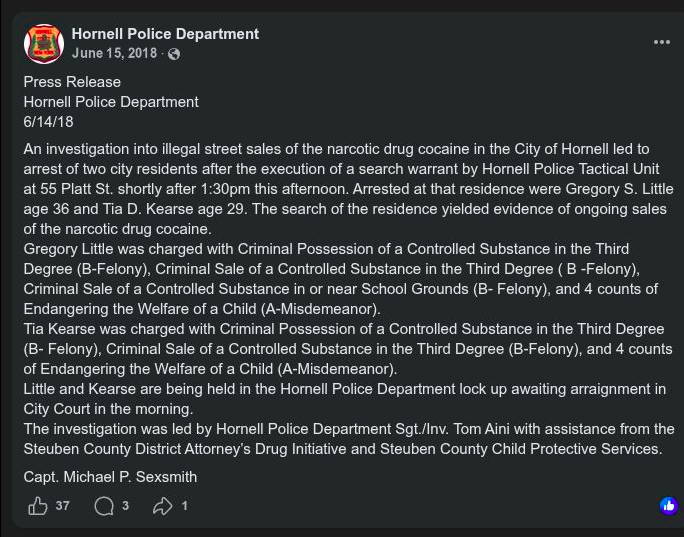
If any case could be more illustrative and devastating to our faith in the systems meant to serve us it is the web of concealment, incompetence and betrayal of public trust surrounding the events in Hornell, NY on July 14, 2018 and their aftermath. Starting with the alleged planting of cocaine and ensuing false arrest by a lead investigator and the implied stamp of approval for those actions by way of a failure to intervene by the department’s chief.
But that is only where this story begins..
What happened on Platt Street that morning was not an isolated act by one rogue officer. It was the visible tip of a gigantic glacier, goliath in proportions; a stack of institutional failures so complete, so interlocking, and so deliberately left unexamined that it reads less like a series of mistakes and more like a system functioning exactly as intended. Consider the multitude of simultaneous failings that facilitated this case’s disappearance the way it did.
First, the police department had to arrest a family on an official ‘factual’ record that a federal court would later find implausible and then face no internal consequences whatsoever. The chief who was named a co-defendant for failing to intervene had to remain in command. The officer at the center of it all had to not only keep his badge but receive a formal commendation from the city’s own Board of Public Safety. All of that happened. It is on the public record.
Next, the city’s elected leadership had to authorize a confidential settlement paid with public money and then say nothing to the public that funded it. The Mayor, who chairs the very Board of Public Safety responsible for civilian oversight of HPD, had to look at that settlement and that commendation and find nothing worth explaining to the residents of Hornell. That happened too.
Going even further, the Steuben County District Attorney’s office had to go on prosecuting cases
in which Sergeant Aini and Chief Murray appeared as witnesses or affiants without ever being
publicly asked whether his Brady/Giglio file reflected the federal litigation
and settlement that a constitutional disclosure obligation may have required
them to know about and act on. The silence from that office has been total;
a silence that constitutes a quiet betrayal of every defense attorney who
ever cross-examined Aini or Murray, or defended one of their victims, in a Steuben County courtroom without knowing what the federal record contained.
And further still, the local press; the Hornell Evening Tribune, the Hornell Sun, the local radio stations, the regional television news desks in Elmira and Rochester and Binghamton whose broadcast footprint covers Steuben County; every outlet whose singular civic purpose is to hold local power accountable to the people it governs had to look at a live federal civil rights case against the city’s police department and find nothing worth covering. Not the filing. Not the motions to dismiss. Not the Magistrate’s Report and Recommendation on qualified immunity. Not the settlement. None of it. Not one outlet. Not one reporter. Not one editor who looked at the public federal docket and thought the residents of Hornell and Steuben County had
a right to know that their police department was fighting, and ultimately paying to escape, a federal civil rights case in their name and with their money.
A case that was eventually cited in the Harvard Civil Rights-Civil Liberties Law Review never made the front page of the local paper of record, never led a regional newscast, never prompted a single on-camera question to the mayor or the chief. The watchdogs did not bark. Every one of them failed the communities they’re meant to serve.
Finally, as my heaving chest gasps for much needed air, the most quietly devastating of all: the courts themselves had to erase the people most harmed by what happened on Platt St. that summer day in 2018. Four children watched their parents arrested in their own home. Four children watched their parents accused of possessing hard narcotics. Four children were placed in foster care within weeks. Four children were the human center of every due process claim that drove this litigation forward. And four children had no legal voice in the federal proceedings that were nominally conducted on their behalf and dismissed at the screening stage under the same procedural doctrine that a Harvard Law professor would later cite Kearse v. Aini to illustrate as formalistic, exclusionary, and fundamentally unjust to the most vulnerable litigants in the federal system. Five institutions. Five failures. One family. One city.
Hornell, New York sits in Steuben County, one of the poorest counties in New York State. It is the kind of place where people know their neighbors, where the police chief’s name is known at the diner counter, where the mayor is someone you might have gone to school with. It is the kind of place where institutional accountability is supposed to be easier, not harder. Where the distances are shorter, there’s always a familiar face and, in the nostalgic theme set by Cheers, your name is never completely unknown allowing nowhere obvious to hide.
And yet. The Kearse family fought back. Without lawyers. Without money. Without a single institution in their city working in their favor. They walked into federal court pro se and they made their case well enough that a federal judge refused to throw it out – not once. Twice. They cleared every legal bar placed in front of them. They forced the City of Hornell to write a check. And the city paid. And nothing changed. And nobody covered it. This series intends to change that..