
Present complex truths accessibly; condescension erodes trust.
Interpretation of the Law
Ethical influencers master the art of making sophistication feel like simplicity. They illuminate rather than intimidate, empowering audiences to grasp profound truths without feeling diminished. Cicero, the Roman orator who shaped Western rhetoric, taught that true persuasion begins with meeting the audience where they stand; adapting complexity to their understanding while preserving intellectual rigor.
P.T. Barnum, the 19th-century showman, built an entertainment empire not by mocking his crowds’ curiosity, but by crafting spectacles that made ordinary people feel like insiders to extraordinary wonders. He staged events, like an elephant plowing his Connecticut field, that incited the press to write “glowing accounts”; effectively turning spectacle into shared discovery.
Modern exemplar, Bellingcat explains satellite geolocation and OSINT tools as if teaching a bright 12-year-old; amassing 10 million readers who trust their process because it feels approachable.. almost warm.
The law demands restraint: withhold jargon, unpack abstractions and frame insights as collaborative discoveries. Audiences reward those who elevate without condescension with fire forged loyalty that withstands the hammer of scrutiny.
Observance of the Law
Consider the Roman Forum in 63 BCE, where Cicero carolled to a crowd of politicians, peddlers and plebeians his cacklings of Catilinean conspiracy. Refraining from ranting on esoteric philosophy he used vivid metaphors: “How long, Catiline, will you abuse our patience?” Drawing from everyday Roman life to make abstract treason palpable. His rhetoric thrived because it honored the audience’s intelligence, drawing on shared cultural references while eluding assumptions of elitist education.
Fast-forward to 1840s America, where P.T. Barnum promoted “General Tom Thumb”, a 5-year-old Charles Stratton trained to impersonate Napoleon along with a cradle of other characters. Rather than lecture on dwarfism, Barnum presented him to newspaper editors, allowing reporters to experience the “miniature marvel” firsthand. Crowds felt clever for “discovering” the phenomenon, not lectured to by a superior showman. Barnum’s belief that “every crowd has a silver lining” hinged on accessibility that transformed sure skepticism into enthusiastic endorsement.
Contrast this with modern failures like CNN’s Jim Acosta; who, during White House press briefings in 2018, often adopted a lecturing tone toward Trump supporters which earned him accusations of condescension that alienated millions. Gallup polls show media trust plummeting ~70% among conservatives when perceived as elitist. Meanwhile, Bellingcat’s MH17 investigation tutorial breaks geolocation into palatable steps, “zoom here, match shadows” etc., that empowered citizen journalists worldwide.
The principle endures because human psychology favors empowerment over diminishment. Cognitive load theory confirms that complex ideas presented accessibly reduce resistance, enhancing retention. Ethical influencers like Cicero, Barnum, and Bellingcat build networks of trust by assuming audience capability, not exploiting perceived inferiority.
Keys to Influence
Analogize Relentlessly: Frame technical concepts through familiar metaphors (Bellingcat: “Satellite shadows work like sundials”).
Ask Collaborative Questions: “Notice how this timestamp doesn’t match? What does that suggest?”; makes your audience co-investigators.
Layer Complexity: Start simple, add depth for engaged readers (Murrow’s radio broadcasts layered facts over emotion).
Test Accessibility: If your mother/grandmother understands it, it’s ready.
Celebrate Audience Insight: “Readers spotted this before we did and here’s the verification.”
Avoid Jargon Traps: Every acronym explained on first use; technical terms get plain-English equivalents.
Transgression of the Law
Violating Law 1 invites swift backlash as audiences detect condescension, eroding the fragile foundation of trust essential to influence. Leaders who outshine through superiority –deploying jargon, lecturing from imagined heights, or framing insights as elite privileges– trigger resentment that unravels their authority. History reveals this pattern: Roman general Crassus alienated allies by boasting esoteric battle knowledge, fostering envy that doomed his Parthian campaign; his severed head became a theatrical prop for the barbarians at the gates in 53 BCE. In modern arenas, academics like those in the 2016 “Grievance Studies” hoax exposed their own ivory-tower like arrogance when hoax papers sailed through peer review, only to collapse under public scrutiny, revealing how condescension blinds influencers to their own vulnerabilities.
Psychologically, it’s the Dunning-Kruger effect in reverse: superiors assume audience inferiority, ignoring that perceived belittlement activates defensive cognition, which spikes cortisol and closes minds to persuasion. Politicians have aptly exemplified this fail: Hillary Clinton’s 2016 “basket of deplorables” remark painted supporters as irredeemable, hemorrhaging swing-state loyalty and handing Trump cultural ammunition. Tech influencers peddling crypto jargon without translation suffered similarly crashes –FTX’s Sam Bankman-Fried lectured on “effective altruism” amid fraud, alienating retail investors who felt mocked, accelerating his 2022 implosion. Consequences compound: lost elections, boycotts, viral backlash. Audiences forgive complexity; they never forget diminishment. The power dynamic flips once the influencer appears arrogant the crowd wields the true power of veto, starving the offender of attention and refocussing it towards rivals who honor intelligence.
PURPLE SHADOW: Condescending “Just Asking Questions” (JAQing Off)
The Deception Pretending humble curiosity while planting manipulative seeds through bad-faith “questions” that imply answers without evidence. The influencer appears thoughtful, “I’m just asking questions”, while steering audiences toward predetermined conclusions, condescendingly assuming viewers can’t handle direct claims.
The Self-Destruction Discerning audiences recognize the pattern: questions that always point in one direction never exploring alternatives. Credibility collapses when real investigators expose the selective framing. Legal liability mounts from defamation suits, as more courts reject “just asking” being used to feign journalistic innocence.
Real-World Examples
– Alex Jones (InfoWars): “I’m just asking if Sandy Hook was a hoax?” got him hit with a $1.5 billion defamation verdict after “questions” incited harassment.
– CNN’s Jim Acosta (2018): Endless “What did he know and when?” about Russia without evidence, fueling “fake news” narrative and trust erosion.
– Breitbart “Questions Remain” Stories: Imply guilt through innuendo, later retracted under pressure, seriously damaging the outlets ‘rigor’ reputation.
The shadow promises quick influence but delivers swift obsolescence. True Purple influencers state claims boldly with evidence; shadows hide behind faux humility, crumbling under scrutiny.
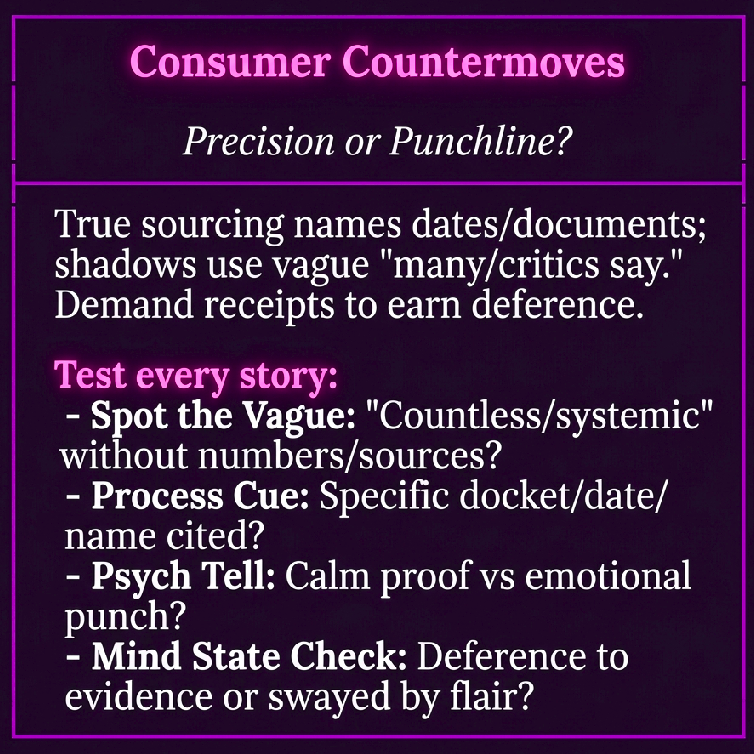
Manipulative media relies on intellectual intimidation, making you trust by deference instead of understanding. True purple literacy means never letting anyone outshine your intelligence.