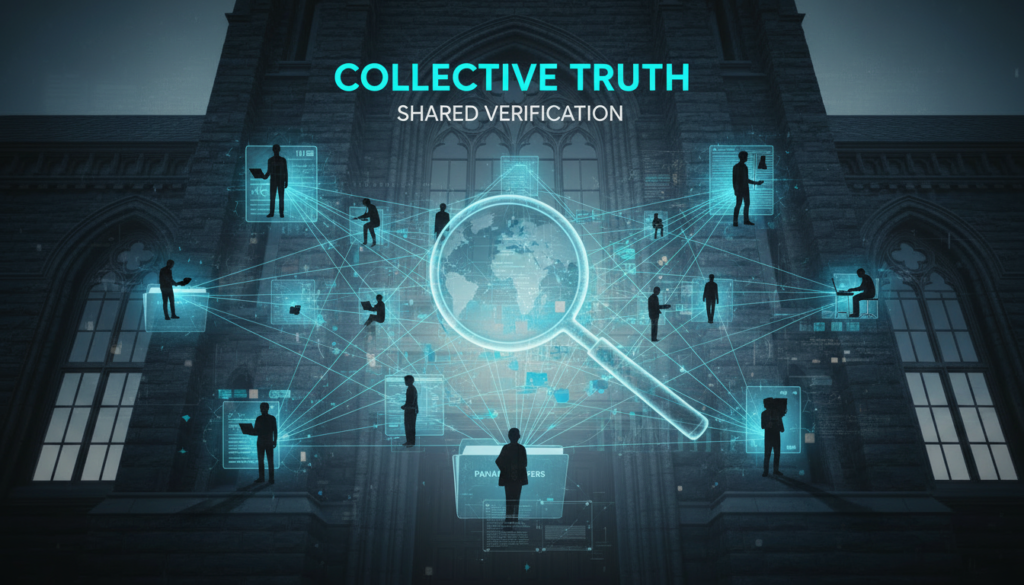
Co‑verified investigations multiply credibility and distribute risk.
Interpretation of the Law
How many of the most influential, powerful and narrative altering investigations in history were solo performances? Compare to how many were orchestrated ensembles tuned to the scale of shared verification.
When two reporters at Süddeutsche Zeitung received 11.5 million leaked files from the Panamanian law firm Mossack Fonseca, they didn’t hoard the scoop to immortalize themselves or their paper. What they did was call the International Consortium of Investigative Journalists (ICIJ) and within months more than 300 reporters on six continents were quietly poring over the data, matching shell companies to presidents, prime ministers, drug traffickers and billionaires.
Each newsroom brought something the others lacked in terms of local language, corporate records, court archives, cultural context, and risks too great for any one outlet to bear alone. By the time the Panama Papers published in coordinated front pages around the world in April 2016, no government could plausibly dismiss it as a partisan hit job. The story’s credibility was mounted on a latticed network of double and triple cross‑checked reporting rather than a single brand. The alliance alone was proof of seriousness.
Ethical influence follows the same logic. A fact borne by one outlet can be waved away as bias but a finding co‑verified across independent organizations becomes reality that power must answer to; a system of shared verification that annexes isolated truth‑tellers to a networked immune system.
Observance of the Law
In the early 1900s, S.S. McClure ran a scrappy magazine that became a progressive juggernaut by understanding this law before it had a name. He recruited Ida Tarbell, Lincoln Steffens, and Ray Stannard Baker, each a formidable muckraker, and did something radical for its time: he synchronized their investigations.
Steffens went after the rot in America’s cities in The Shame of the Cities; Tarbell dissected Rockefeller’s monopoly in The History of the Standard Oil Company; Baker exposed labor abuses and race violence. Published together in McClure’s, their work did more than indict individual villains. It painted a mural on the walls of justice that depicted corrupt city bosses, predatory trusts, and complicit institutions forming a single egregious ecosystem of exploitation.
Crucially, the McClure alliance shared sources, methods, and editorial standards. When Tarbell described rebate schemes in oil, and Steffens described kickbacks in municipal contracts, patterns emerged that neither could have proven alone. Their shared verification made it impossible for industry or government to dismiss each exposé as an isolated grievance. By 1911, Standard Oil was broken up under the Sherman Antitrust Act, and city reform movements swept the country. An editorial and investigative alliance had altered the trajectory of American law.
Decades later, another alliance would prove just as consequential. In 1971, military analyst Daniel Ellsberg leaked a 7,000‑page classified history of U.S. involvement in Vietnam lovingly referred to as the Pentagon Papers. The New York Times began publishing excerpts and immediately faced an injunction from the Nixon administration under the Espionage Act. In that moment, the law of shared verification would decide whether the truth lived or died.
The Washington Post, initially shut out and under pressure from its own lawyers, could have ceded the field. Instead, its reporters tracked down Ellsberg, obtained their own copy of the documents, and began independent verification. Within days both papers were publishing and more outlets joined. The Supreme Court ultimately ruled 6-3 that prior restraint was unconstitutional, with multiple justices noting implicitly that the public interest outweighed the government’s vague claims of “irreparable harm.”
By acting together, informally but decisively, the Times and the Post turned a single paper’s “reckless leak” into a national reckoning. Shared verification transformed one outlet’s risk into a collective defense of press freedom.
In the 21st century, ICIJ made this law explicit. Offshore Leaks, Swiss Leaks, Luxembourg Leaks, and ultimately the Panama Papers all followed the same playbook: one outlet receives a leak, then invites dozens, sometimes hundreds, of others into a confidential verification network spanning 80+ countries. They exchanged leads through encrypted platforms, matched names across company registries and court records, and used local reporters to confirm which shell companies actually existed and were relevant.
Bellingcat applied similar principles in the open‑source realm. Its MH17 investigation used a volunteer hub where contributors across 20+ countries verified photos, geolocated videos, and cross‑checked license plates and convoy routes. No single analyst “owned” the story; the credibility came from the convergence of hundreds of independent checks into a coherent, documented picture linking a Russian Buk missile launcher to the downing of the civilian airliner. Years later, European courts and official investigations confirmed what a decentralized alliance of civilians had already established.
The psychology is straightforward: when multiple independent actors, with different incentives and audiences, arrive at the same conclusion using different paths, the human mind reads that as truth. Social sciences call it triangulation (or inter-rater reliability(IRR)) – a chorus of independent eyes, aligned in verdict that render deception powerless.
For ethical influence, the lesson is simple and ruthless: the lone wolf is romantic, but the pack is more persuasive.
Keys to Influence
Invite Competent Rivals In, Early When you obtain explosive material, resist the urge to hoard. Identify at least one outlet or investigator with a different audience and perceived bias, and bring them into the verification process under clear ground rules. Signal sent: “We fear error more than we fear sharing credit.”
Build a Verification Commons Create shared databases, document repositories, and timelines that collaborators can access and improve. ICIJ’s secure platforms for leak analysis and Bellingcat’s Volunteer Hub are blueprints.
Synchronize Publication, Diversify Framing Coordinate dates and embargoes, but let each outlet tell the story in its own voice to its own audience. The power of the Panama Papers was not one front page, but a global chorus on the same day. Signal sent: “This isn’t one factions narrative, it’s a documented reality.”
Design Red‑Team Roles Assign at least one partner whose explicit job is to doubt you: to question assumptions, stress‑test evidence, and attempt to falsify the central claim before publication. Signal sent: “We tried to prove ourselves wrong and failed; here’s what survived.”
Share Risk, Share Shield Legal threats, smear campaigns, and cyberattacks land differently when dozens of organizations stand behind the same findings. The Pentagon Papers case and the Panama Papers alike showed authorities that there was no single head to cut off. Signal sent: “Intimidating one of us means confronting all of us.”
Credit the Network, Not Just the Node Put partner logos on landing pages, list collaborating reporters prominently and describe the collaborative process in your methodology notes. Signal sent: “This is bigger than any one brand.. including ours.”
Transgression of the Law
Rushing to judgment shatters credibility when premature, unverified narratives crumble under scrutiny, transforming influencers into objects of ridicule and eroding their long-term power. Eager to seize attention, transgressors amplify unverified claims –chasing viral outrage or partisan applause– only to face retractions that expose their haste as bias or incompetence. Historical precedents abound: in the 1692 Salem witch trials, Cotton Mather rushed spectral (read scant) evidence into print without verification, fueling hysteria that executed innocents and later branded him a fanatic whose influence waned amid public remorse. Yellow journalism king William Randolph Hearst exacerbated the 1898 USS Maine explosion with unproven Spanish sabotage claims, propelling war but earning postwar contempt as audiences learned the truth from independent probes.
Psychologically, this stems from confirmation bias amplified by speed: outlets prioritize “scoops” over evidence chains, exploiting the audiences emotional peaks before reason intervenes. Modern media failures illustrate the fallout: CNN’s 2017 Russia-Trump “pee tape” rush, based on an unvetted dossier, fueled impeachment fever but collapsed in Mueller’s 2019 report, slashing Republican trust to historic lows per Gallup.
Fox News’ 2020 Dominion voting machine defamation pushed election fraud claims before it yielded a $787 million settlement in 2023, alienating moderates. Covington Catholic’s 2019 viral video rush smeared teen Nick Sandmann as racist without full footage; retractions came too late, costing media outlets lawsuits and audience defection. Consequences cascade, usually more exponentially than by increments: legal payouts, advertisers flee, partisan silos are created that starve broader reach. The power dynamic inverts and rushed, impatient influencers become institutional statistics who eventually cede narrative control to the patient verifiers claiming the ethical high ground.
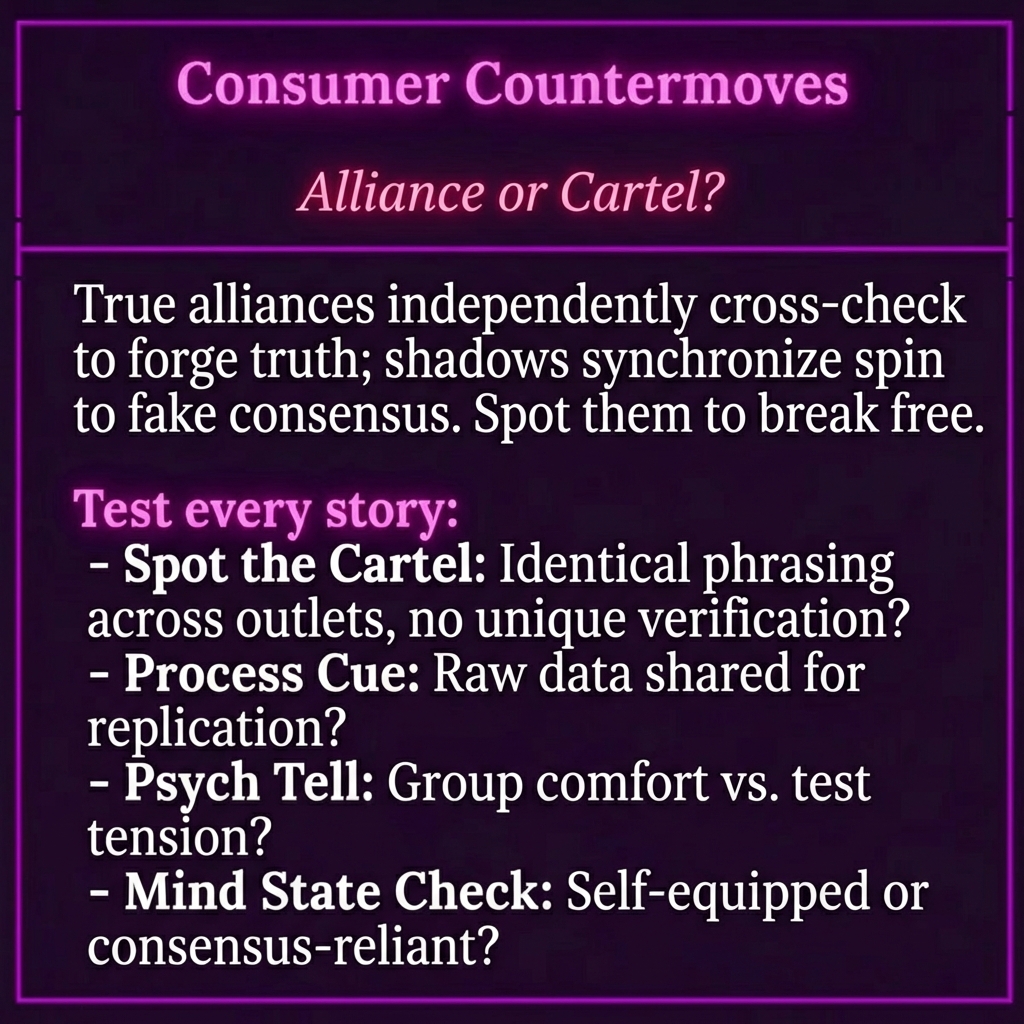
PURPLE SHADOW: Alliance or Cartel
The Corrupted Version
The Deception Power can mimic this law by forming “alliances” not to verify truth, but to standardize spin. Governments, corporations, or partisan media coalitions coordinate narratives, synchronize talking points, and share “opposition research” under the guise of collaboration. Instead of many independent verifiers strengthening a story, you get a messaging cartel repeating the same untested claims.
On the surface, it looks like consensus: “Everyone is saying this, so it must be true.” In reality, the same unverified assertion is laundered through multiple outlets drawing from a single, self‑interested source.
The Self‑Destruction When the underlying claim collapses, the entire alliance loses credibility at once. Audiences realize they were not hearing independent confirmations, but echoed talking points. Trust decays faster than if one outlet had erred alone, because the realization is not just “they were wrong,” but “they were coordinated.”
Real‑World Examples
The Iraq WMD Media Consensus (2002–2003) Major U.S. outlets –from The New York Times to network television– repeated the Bush administrations claims of weapons of mass destruction based heavily on the same thin intelligence, much of it from defectors like “Curveball” and unnamed officials. There was no genuine cross‑verification; there was a well rehearsed chorus. When no WMDs were found the public saw not just individual journalistic failure, but systemic alignment with power. Media trust cratered and was weaponized for decades afterward.
Coordinated “Tough on Crime” Narratives (1980s–1990s) Local news, national outlets, and political campaigns reinforced each other’s stories about a coming crime wave and “superpredators,” often based on selective statistics and racialized anecdotes rather than longitudinal data. Shared framing created the illusion of independent confirmation. The result was mass incarceration policies later acknowledged as harmful and racially biased; media and politicians alike had to walk back years of “consensus” that had never been rigorously verified.
Astroturf Think‑Tank Networks Corporations have funded webs of think tanks and advocacy groups that issue aligned reports, op‑eds, and media hits presenting industry‑friendly findings as if they emerged from diverse, independent centers of expertise. Only later do investigations reveal the common funding streams and coordinated messaging strategies. What once looked like a chorus of confirmation is exposed as a choir on a single payroll.
In each case, the shadow looked like Law 2 from the outside: multiple voices, shared messaging, apparent consensus; but lacked its soul: genuinely independent actors trying to disprove one another and arriving at the same truth.
The Purple path uses alliances to stress‑test reality; the Shadow path uses alliances to manufacture it. The first builds legacies like the Panama Papers. The second builds pyres that eventually consume their architects.