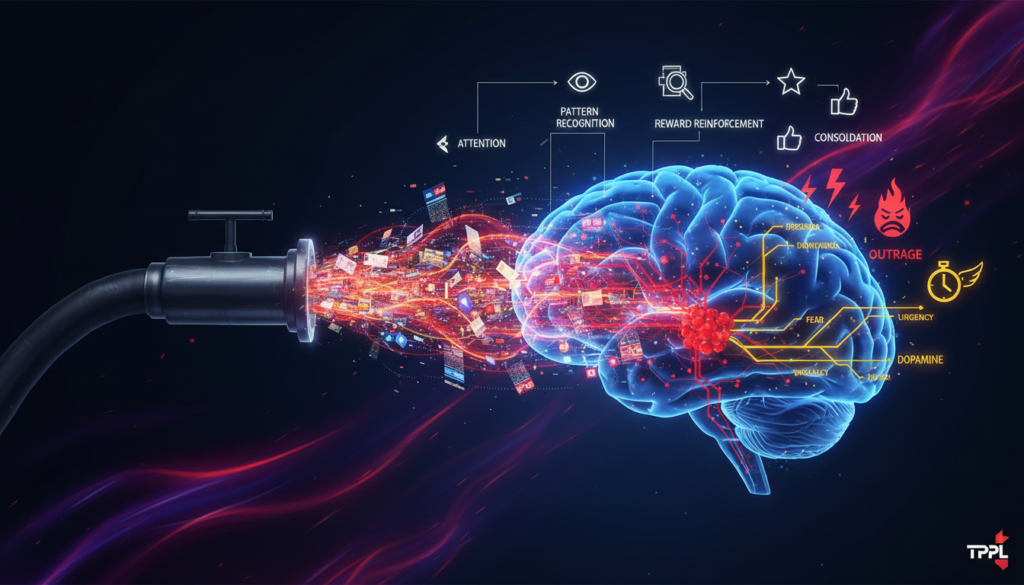
“The firehose doesn’t lie, it exploits. And your brain’s reward system is its most effective weapon.”
In The Firehose of Falsehood, we explored how propaganda spreads through volume, speed, repetition, and no commitment to truth. But there’s a deeper layer: why do these lies feel true?
The answer isn’t in the content; it’s in the cognitive architecture of the human mind.
The firehose doesn’t work because it’s persuasive. It works because it hijacks the brain’s reward system.
The Neuroscience of Belief
Before we dissect the firehose, let’s understand how the brain believes.
Belief is not a rational process. It’s an emotional one.
When we encounter a claim, our brain doesn’t run a logical algorithm. It asks:
“Does this feel right?”
And dopamine – the brain’s reward chemical, is the arbiter of “rightness.”
How Dopamine Works
Dopamine is released when we encounter patterns, especially surprising, emotionally charged ones.
The firehose is designed to exploit this:
– Emotion → triggers dopamine
– Repetition → reinforces neural pathways
– Speed → hijacks attention
– No truth commitment → avoids cognitive dissonance
“A lie that feels true isn’t believed because it’s rational – it’s believed because it feels right.”
The Four-Stage Hijack
The firehose doesn’t just spread lies. It triggers a four-stage cognitive hijack, a sequence that turns attention into belief.
1. Attention Hijack
– Trigger: A viral video of a “crime wave” or “immigrant invasion”
– Emotion: Fear, outrage, urgency
– Neural Mechanism: Amygdala activation → fast response, bypassing prefrontal cortex
– Result: You’re now emotionally engaged, not rationally evaluating
“This is happening. It’s real. I must act.”
2. Pattern Recognition
– Trigger: The brain scans for familiar narratives
– Pattern: “This is just like 1992!” → confirmation bias kicks in
– Neural Mechanism: Hebbian learning – “neurons that fire together, wire together“
– Result: The story is now anchored in your memory
“This has happened before. I know this story.”
3. Reward Reinforcement
– Trigger: Sharing the meme = social validation
– Neural Mechanism: Dopamine surge → “This feels right”
– Result: Belief is now rewarded, not reasoned
“I’m right. And I’m not alone.”
4. Consolidation & Memory
– Trigger: The story is repeated across platforms
– Neural Mechanism: Each repetition strengthens the neural pathway
– Result: The lie becomes “truth” in the brain’s memory
“This is fact. I know this.”
The Real-World Test: The “Distracted Boyfriend” Meme
Take the “Distracted Boyfriend” meme. It’s not just a joke it’s a perfect firehose:
– Emotion: Humor, schadenfreude
– Pattern: “He’s leaving you for something better” → universal narrative
– Reward: Viral spread = social status
– Memory: Repeated = believed
“The meme isn’t about politics. It’s about how we believe.”
The Antidote: Cognitive Immunization
To resist the firehose, we need cognitive vaccines, tools that expose the hijack before it takes hold.
The “Dopamine Checker” – A 30-Second Belief Audit
Before you share a story, ask:
1. What emotion does this trigger? (Fear? Anger? Pride?)
2. Is this a pattern, or a fact? (Is it a narrative, or data?)
3. Would I believe this if it came from the other side?
If yes to 2+, pause. This may be a firehose.
The Takeaway: Belief Is Not Truth
The firehose doesn’t work by deception. It works by exploiting the brain’s reward system.
And the antidote isn’t more facts.
It’s awareness.
“The best defense isn’t truth; it’s awareness.”