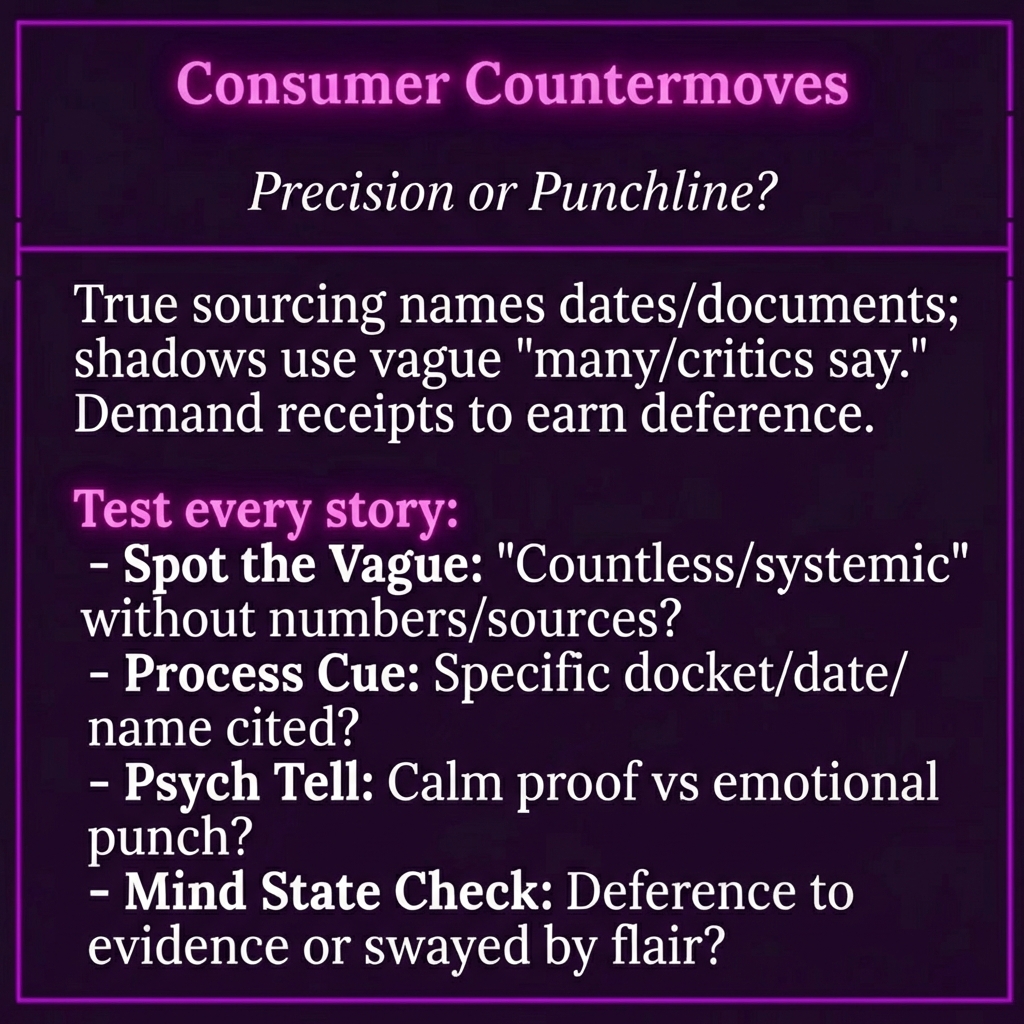
Precise sourcing withstands attacks and turns doubt into deference.
Interpretation of the Law
The most feared sentence in any newsroom used to hang on the wall in block capitals: “IF YOUR MOTHER SAYS SHE LOVES YOU, CHECK IT OUT.” It’s half joke, half doctrine. It’s a simple message: ‘nothing is exempt from verification, and nothing should be said more strongly than you can prove.’
Few embodied that discipline more fiercely than Ida B. Wells. In the 1890s, when white newspapers repeated rumors about Black men as justification for lynching, Wells did something almost no one else had done: she counted. She compiled lynching reports from the Chicago Tribune and dozens of local papers, cross‑checked names, locations, alleged offenses, and outcomes, and produced tables of 728 cases with dates, places, and purported causes. In Southern Horrors and A Red Record, she did not say “many lynchings are lies”; she wrote, “Of 134 Black men reported lynched in 1894, only about one‑third were even accused of rape; and some of those for ‘writing letters’ or ‘asking a white woman to marry.’”
By speaking in numbers, dates, and primary sources, Wells turned what white editors called “Negro agitation” into an indictment no honest reader could escape. When Southern officials tried to discredit her, they had to argue not with her adjectives but with her tables; and they couldn’t.
That is the heart of this law: precision shackles power. Every time you trade a specific for a flourish, you weaken the chain.
Observance of the Law
In June 1972, two young reporters at The Washington Post, Bob Woodward and Carl Bernstein, started chasing what looked like a local oddity: five burglars in business suits caught inside the Democratic National Committee offices at the Watergate complex. They could have framed it as “political dirty tricks” and moved on. Instead, they developed an unwritten rule: no allegation of criminal wrongdoing would appear in print without at least two independent sources confirming it.
When an FBI source hinted at a secret fund inside the Committee to Re‑Elect the President (CREEP), they didn’t write “sources say millions in hush money.” They wrote that a named official, Hugh Sloan, had testified to a grand jury that at least $350,000 in campaign funds was controlled by Attorney General John Mitchell, and that disbursements had been tracked through specific bank accounts and checks. Every dollar was nailed to a document or a human being.
That precision nearly bored some editors. But it saved them. For two years, the White House called their work “shabby journalism” and “fantasy.” Yet each story was a wall of small, correct facts: dates of meetings, exact sums, names of cash couriers, links between burglars and the re‑election committee. When the Senate hearings and the White House tapes finally confirmed the pattern, the Post’s credibility was not just intact, it was untouchable. They had never said more than they could prove.
Contrast that with outlets that got lazy with language and paid dearly. In 2019, former sheriff Joe Arpaio sued CNN, Rolling Stone, and HuffPost for defamation. CNN described him as having been “found guilty of criminal contempt,” which was accurate; they avoided terms like “felon” and did not claim he had been sentenced to prison. The court threw out the claim against CNN under the “substantial truth” doctrine: minor imprecision does not matter if the gist is correct.
Rolling Stone and HuffPost were not so careful. One called Arpaio an “ex‑felon”; another said he had “served time in prison”; both claims were false. He had been convicted of a misdemeanor, then pardoned. Those extra words, added for punch, almost cost them millions. The court ultimately dismissed for lack of proven actual malice, but the judge’s reasoning underscored the risk: when you go beyond what your documents say, you hand your target a weapon.
Investigative outlets that survive high‑stakes lawsuits all converge on the same lesson. In a libel case against Reveal (from the Center for Investigative Reporting), the British charity Planet Aid claimed defamation over a foreign‑aid fraud investigation. Discovery forced Reveal to turn over hundreds of thousands of internal documents and 500 audio recordings of interviews in Denmark, Malawi, and the U.S. The judge ultimately dismissed the suit, noting that the reporters had engaged in “the typical editorial process of fact‑checking and revising drafts” and confirming the reliability of their information. The reporting survived not because it was passionate, but because it was documented; painstakingly, exhaustively, sometimes boringly documented.
At the core of all this sits something more human than style or doctrine: respect. When you name the county, the date, the docket number, the page, you are telling your audience: I assume you care enough to look. That assumption is itself a form of ethical influence. It treats people not as spectators of your performance, but as potential co‑investigators.
Neuroscience and psychology echo this. Studies on persuasion show that specific, verifiable claims foster what researchers call “epistemic trust”; confidence, not just in a person, but in their way of arriving at conclusions. Vague generalizations may inflame emotions, but they don’t change how people decide what is true. Precise sourcing does.
Ethical journalism and influence –if they are to be up to an impressive standard– must be built on this unforgiving discipline: say exactly what you can prove, then back it with receipts.
Keys to Influence
Name, Don’t Gesture “A sheriff in Arizona” is a gesture. “Sheriff Joe Arpaio of Maricopa County, convicted of criminal contempt in July 2017 in case CR‑16‑01012‑001‑PHX‑SRB” is a fact train. If you don’t have that level of detail, you don’t have a claim yet.
Write With the Transcript in Mind Assume your article or segment will be read aloud in a deposition, with a lawyer stopping after each sentence: “What’s your source for this?” If you can’t answer in one sentence; “Blix’s UNMOVIC briefing to the Security Council, March 7, 2003” then cut or rephrase it.
Quantify Whenever Honest “Many lynchings were not about rape” is forgettable. “Of 134 reported in 1894, only about one‑third involved rape accusations; some were for ‘writing letters to a white woman’” sticks like a nail.
Adopt a Two‑Source Rule for Accusations Follow Woodward and Bernstein’s unwritten rule: no allegation of criminal or serious ethical wrongdoing without at least two independent sources or one source plus a primary document. Your future self will thank you.
Separate Fact from Frame Put the verifiable core in plain, neutral language; reserve adjectives for interpretation. “UNMOVIC conducted more than 400 unannounced inspections at 300 sites in Iraq” is bulletproof; “Iraq played a cat‑and‑mouse game” is a gloss.
Keep a “Source Ledger” Maintain an internal spreadsheet logging each factual claim, its source (document ID, interview timestamp, database), and its confidence level. If sued, that ledger becomes your shield.
Transgression of the Law
Imprecise sourcing unleashes vulnerabilities that adversaries exploit, converting potential triumphs into credibility craters as unchecked flourishes invite relentless takedowns. Transgressors favor emotional punch over pinpoint facts, opting for “systemic fraud” sans ledgers or “hate leader” without dockets; crafting narratives that thrill initially but shatter when precision probes reveal overreach. In 1890s journalism, William Randolph Hearst’s New York Journal rushed “Spanish atrocities” in Cuba with vague “eyewitness” claims untethered to names or dates, igniting the 1898 Spanish-American War but earning postwar scorn as “yellow journalism” when verified reports exposed fabrications, costing him circulation dominance to major rivals like Pulitzer.
Psychologically, vagueness leverages the availability heuristic, inflating outrage via fuzzy generalizations that bypass scrutiny until motivated challengers demand specifics, triggering backlash. Modern examples abound: ABC News’ 2012 “pink slime”/Lean Finely Textured Beef report labeled it “filler” without USDA docket citations, prompting a $177M settlement in 2017 after Beef Products Inc. proved defamation through source precision. Gawker’s 2015 Hulk Hogan sex tape coverage amplified unverified “celebrity scandal” without consent logs or privacy precedents, leading to a $140M verdict that bankrupted the site. Dominion Voting Systems’ 2021 suits against Fox News and others hinged on imprecise “stolen election” claims absent ballot audits or chain-of-custody documents, yielding $787M Fox payout in 2023. Fallout escalates: multimillion dollar judgments, editorial overhauls, audience exodus. When the power inverts imprecise voices cede deference to those whose receipts withstand sieges, creating fortresses built on professional rigor.
PURPLE SHADOW: Vague Punchlines, Blunt Lawsuits
The Deception You learn the rhythms of gripping narration: “countless,” “systemic,” “everyone knows,” “it’s been said that…”. You punch up headlines with loaded labels –“ex‑ felon”, “fraudster”, “hate‑group leader”– because they feel emotionally true, even when your documents don’t quite support them. You attribute to “critics say..” what you cannot prove yourself. It feels righteous. It feels powerful; and it is, for a while.
The Self‑Destruction Then someone with money and lawyers decides they’ve had enough. In discovery, every flourish is put on the table. “Where did ‘countless’ come from?”, “How many, exactly?” “Who are these ‘critics’? Names, please.” The court doesn’t care about your moral certainty. It cares whether you can tie each contested word to a verifiable source.
When you can’t, two things happen. First, you may survive the suit on technical defenses –public figure standards, lack of actual malice– but you still look sloppy or biased in the written opinion. Second, you bleed time, money, and attention that could have gone into your next investigation. Your staff spends months combing through notes to redact sources and justify phrasing, as Reveal and other outlets have described. Even when you win, you crawl out poorer and less trusted.
Real‑World Examples
Arpaio v. CNN / Rolling Stone / HuffPost (2019) CNN’s carefully worded description, accurately noting Arpaio’s criminal contempt conviction, survived under “substantial truth.” Rolling Stone and HuffPost, by loosely calling him an “ex‑felon” who had “spent time in prison,” handed his lawyers openings they should never have had. Those extra, imprecise words turned a strong story into legal exposure.
Time Inc. v. Firestone (1976) and Its Children In the wake of that case and others, news organizations were reminded that embellishments in high‑society divorce coverage, suggesting moral turpitude beyond the record, could cost millions. The gossip was cheap; the falsehood was not.
Local Investigations Undone by One Loose Line Many investigative reporters can tell the same story: a 5,000‑word exposé backed by months of digging, weakened because one paragraph summarized a rumor as if it were fact. The target seizes that one sentence to discredit the entire piece. In London and other plaintiff‑friendly jurisdictions, that can mean personal financial ruin.
In every case, the shadow path feels exciting at the time. You sound more definitive, more moral, more outraged than your meticulous peers. But the bill always arrives. Ethical influence, at the standard that this book attempts to set, cannot afford that kind of sloppiness.
Purple influence is brutal in its simplicity: if you can’t footnote it, you don’t state it as fact. Precision is not pedantry; it is armor. Document everything, speak exactly, and let those who prefer vagueness learn their lessons in court.